Remote components
When creating a juturna pipeline, all its components are instantiated locally. Whilst this is ideal when developing new nodes and checking that everything works fine on your own machine or container, in many production scenarios having the ability to leverage remote resources, such as GPUs, is not a plus but a must. For this reason, juturna offers the basic infrastructure to deploy nodes remotely, while still using them as if they were local entities. We call this warping.
Warping a node enables the remote execution of that node, included in a local pipe. You can deploy specific nodes as remote services that communicate with the main pipe over the network using gRPC and Protocol Buffers (Google’s protobuf).
This architecture allows a local pipe to offload processing to remote node handlers, which manage the node lifecycle and act as message brokers for incoming and outgoing queues.
The warping mechanism addresses common topics in several deployment scenarios. To name a few, remote nodes are deployed with dependency isolation, so they do not clash with conflicting dependencies from other nodes in the same pipeline. Also, sharing and scaling are strong suits of remote nodes, as they can serve multiple pipelines simultaneously, or be made redundant and masked by a load balancer.
Remotisation features might be unstable (1.0.1-beta)
The infrastructure to deploy juturna nodes remotely is still under active development. We do not recommend using it in production scenarios, or for mission-critical components.
Warping fundamentals
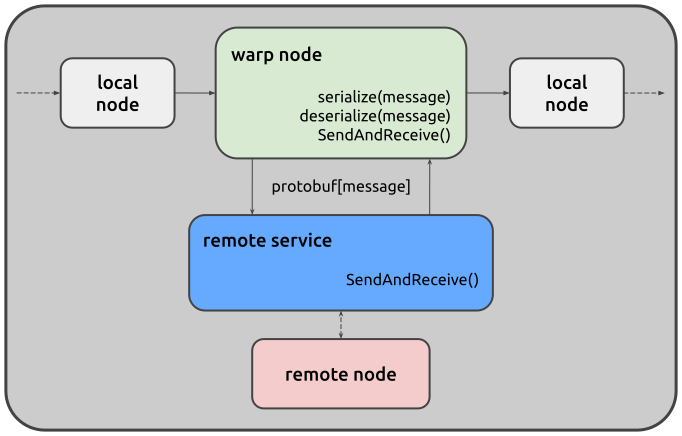
When a node is configured for remote execution, two components work together. On the local side (that is, the main juturna process) a node intended for remote deployment is masked by a warp node. A warp node is a simple processing node acting as local client or proxy for the remote node. Warp nodes are responsible for managing the communication with the remote service behind which the concrete node lives. This means, they receive messages from the pipeline normally, turn them into protocol buffers, send them over the remote service, and then unpack the responses they receive.
On the remote side runs the remote service, a standalone gRPC server that holds the concrete node doing the actual computation work, acting as a publish/subscribe broker for its input and output queues. Similarly to the warp node, the remote service manages the marshalling and unmarshalling of the data received from the local pipe.
State and replicas
The concrete node keeps its state between messages, like a local one. Each warp
node gets its own state on the remote side, even when one remote service serves
several pipelines, and the sticky flag of the warped node tells where that
state lives:
sticky (the default): the remote service keeps the state of each warp node, and sends a copy back with every response. The warp node must always reach the same service. It sends its copy only when the service answers that it does not know it, after a restart or once an idle state was dropped, and the service starts again from that copy.
not sticky: the remote service keeps nothing. The warp node sends its state with every request, the remote node updates it, and the response brings it back. Any replica behind a load balancer can serve any request, and a replica going down loses no state. The state travels on every request, so keep it small.
In both cases the remote service answers when update() returns. A message
that the node keeps in its state without transmitting anything gets an empty
response at once, and the warp node transmits nothing downstream.
What cannot reach the client
Messages and states keep their exact types on the wire: None, booleans,
ints, floats, strings, bytes, lists, tuples, frozensets, dictionaries, numpy
arrays and scalars, and messages. Some things still cannot reach the warp node:
a value of another type (a set, an open file, a model) in the
metaof a message, in anObjectPayloador in the state;a second message transmitted by the same
update(): only the first one is sent back;a message transmitted after
update()returned, for example by a thread of the node: its request was already answered.
By default the remote service leaves them out and logs a warning, once for each client and for each kind of loss: a dictionary loses the entry, a list or a tuple the item, and everything else is sent. A state that loses an entry loses it for good, in the copy kept by a sticky warp node as well, so keep such objects in the node rather than in its state. The warp node does the same with the messages it sends.
Started with --strict, the remote service fails the request with the
DATA_LOSS gRPC status instead, every time. A message transmitted late fails
the next request of its warp node, which is not processed. The warp node
counts the failure in its health, and the pipeline goes on with the next
message.
Developer notes
Juturna installation includes pre-compiled protobuf classes, ready to use out of the box. However, if you need to modify the .proto definitions or recompile them for development purposes, two utility scripts are provided:
juturna/remotizer/compile_protos.sh: Recompiles the .proto files into Python classesjuturna/remotizer/expose_protos.sh: Exports the compiled protobuf classes for external use. This requires to install the additionalprotoletariatdependency.
These scripts should only be needed when modifying the protocol definitions or contributing to the Warp node implementation.